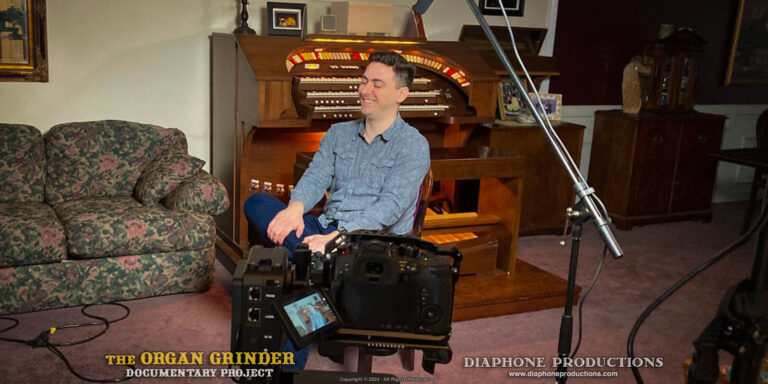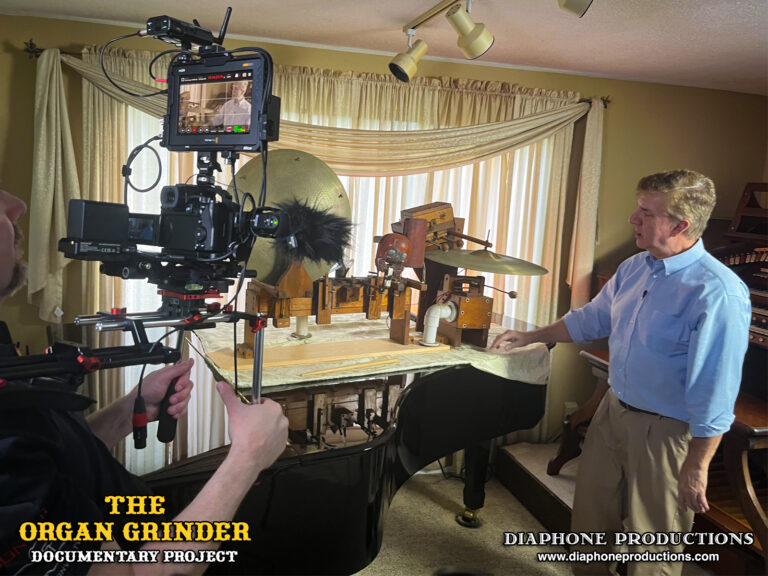
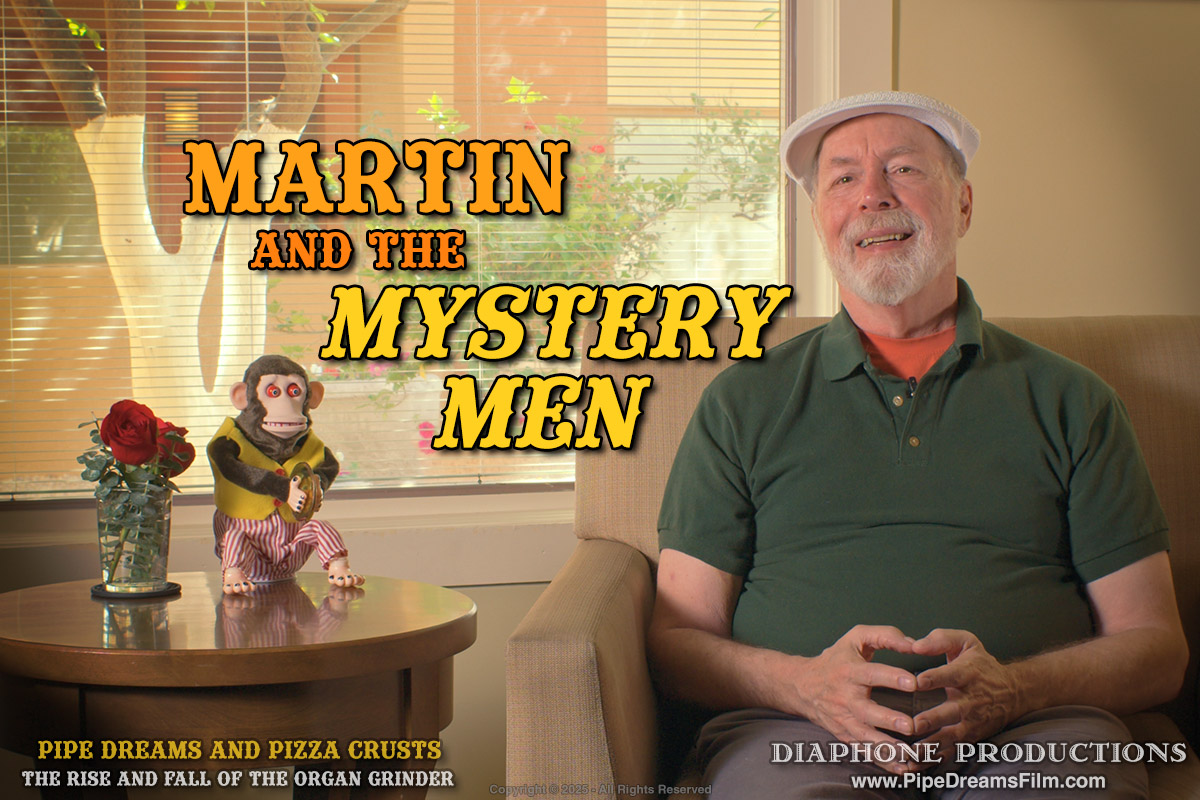
While visiting the Phoenix area during our Southwest Road Trip in November, we interviewed Martin Meier, who has a fascinating story about how he came to acquire the Denver Organ Grinder instrument, and then sadly had to let it go.
Martin and his partner Tim Stoddard owned a bed and breakfast, the Pikes Peak Paradise (which is still in business today under different ownership). Martin and Tim met in 1986, and built and opened the bed and breakfast, based on Martin’s own design, in 1988.
Since childhood, Martin was fascinated with pipe organs. Not just a love for the music they produced, but for the mechanical aspects of the instrument. Martin got his first pipe organ when he was fifteen, a Wicks which was being replaced at a local church. However, that particular Wicks started its life in a theater in Greenville, Texas.
Martin spent a few years tinkering with that instrument and brought it back into operation. In his early 20’s, he encountered his first theatre pipe organ and was enthralled by all of the percussions and extra instruments, and how it sounded like a band or orchestra, and his interests began to gravitate from classical organs to theatre organs.
Martin was taken by a friend to visit Organ Grinder Denver early in the restaurant’s life, around 1980, and became a regular attendee. Working in the aerospace business after moving to Colorado, Martin also became president of a local theatre organ group and was involved in several pipe organ restoration projects.
Organ Grinder Denver had a perilous existence in its final years, changing hands multiple times, and shutting down at least once before its final closure some months later.
The big shutdown was an enforcement action by the City and County of Denver, for unpaid sales taxes. A public auction was held, and it seemed like the entire restaurant was to be liquidated.
(If anyone has dates/times, or copies of newspaper postings, or flyers about the tax auction – or any other closures/auctions – please contact us! There is very little information publicly available.)
A colleague in the Denver theatre organ society chapter notified Martin about the tax auction, and Martin went, intending to make a bid on the organ. He was expecting something of a free-for-all, with individuals buying up every piece of the place. But he encountered something different – and ultimately perplexing:
I would say the crowd was like 50 people in the restaurant that were there to bid on things and I expected there to be more like an auction, but in this case it seemed like there was this group of gentlemen all extremely well dressed, in black suits, and they were over to one side and they kept bidding, and so they were the most frequent bidder.
There were items that went out the door during that auction, for example the big Saturn-shaped mirror ball was sold, but it seemed like this group of gentlemen, anytime anything that came up that was relevant to keeping the restaurant open, these guys would place a bid.
Finally, at the end of the whole auction, they auctioned off the organ, and so that’s when I jumped into action and started waving my little hand and trying to get the attention. And sure enough it was me versus the gentlemen in black that were bidding on the organ.
I bid up to the amount of money that I had brought, not really expecting to walk away with the organ, but it was exciting – and lo and behold they took the top bid, and at the moment I thought well there goes a beautiful organ, I’m sorry to see it go.
But it turns out that was not about to be the end, but the beginning of a mystery that nobody who has spoken to the documentary – at least thus far – has been able to explain:
I had not been standing there probably more than a minute before one of the gentlemen from that group came over to me, and in a very quiet voice he said “We don’t need this organ more than about six months. Can I get your name and phone number because we would like to talk with you when we’re finished with the organ.”
It’s an open question to this day – who buys a restaurant and a pipe organ with the knowledge that they are only going to operate it for six months – and why?
I was very surprised at that, and so we exchanged information, and I got a business card that had the name of an attorney on it. [Name redacted until we are able to contact this individual.]
What was striking is almost six months to the day I got a call, and they indeed were done with the organ and so this [attorney] was a very friendly sort of guy. He almost seemed excited to sell me the organ and it all came together relatively fast. Negotiation probably didn’t last more than a few days, and he said “Okay we have a deal. You transfer your money and you have an organ.”
I have no idea what their plan was for keeping the restaurant open only six months, but it is a tell telling sign that this gentleman came up to me and said that’s what they were going to do.
So it was obviously a planned execution to make this happen this way.
I don’t think anybody gave us any indication as to where anybody was from. I assume there probably were local attorneys involved, but [this attorney] was from San Francisco, and my impression was everything was orchestrated from the West Coast.
(If anyone reading has more information about the West Coast connections, and the reason for operating Organ Grinder Denver for just six more months after purchasing the organ and the fixtures at the auction, please do get in touch!)
They wanted our removal to be supervised, so they hired a security guard to be there. We were there two weeks to remove the organ, and it literally took 12 hours a day with about 12 of us working that whole time to get everything taken apart, crated up and moved out of the restaurant.
The news [of Martin’s purchase] traveled through the organ society pretty fast and a lot of people jumped on board wanting to help us to remove the organ. And so we had a pretty steady crowd of helpers to pack pipes and remove the organ.
We built crates, we put the small to medium pipes in crates, and those all went to our bed and breakfast as well as the console. I remember that Ed Zollman was involved and his primary task was to disconnect the console, and he also helped us in a big way to remove the 32 foot diaphones. The diaphones – we knew that we didn’t really have the space for them – so we immediately put it out there that we would sell those. Mike from Organ Stop Pizza initially contacted me, but they eventually ended up in the Jasper Sanfilippo organ.
About a year after removing the organ from the restaurant, around 1990, Martin and Tim brought parts of the console and the percussions out of storage and set them up in their bed and breakfast, with the intention of eventually getting the instrument operating as an attraction for guests.
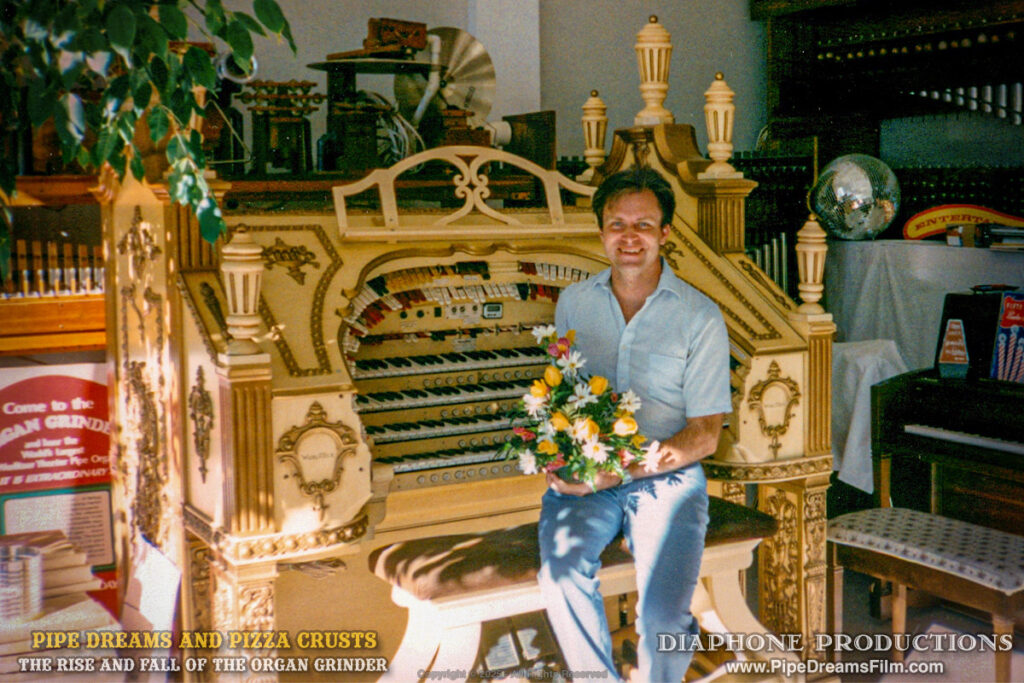
The Denver console originally came from the Paramount Theatre in Portland, Oregon (now the Arlene Schnitzer Concert Hall), before moving to its 2nd home at the Organ Grinder, and then to its third home at Pikes Peak Paradise.
The console is now a part of the Phil Maloof collection in Las Vegas. However, after “Uncle Phil’s” passing in 2020, the future of the collection is in flux.
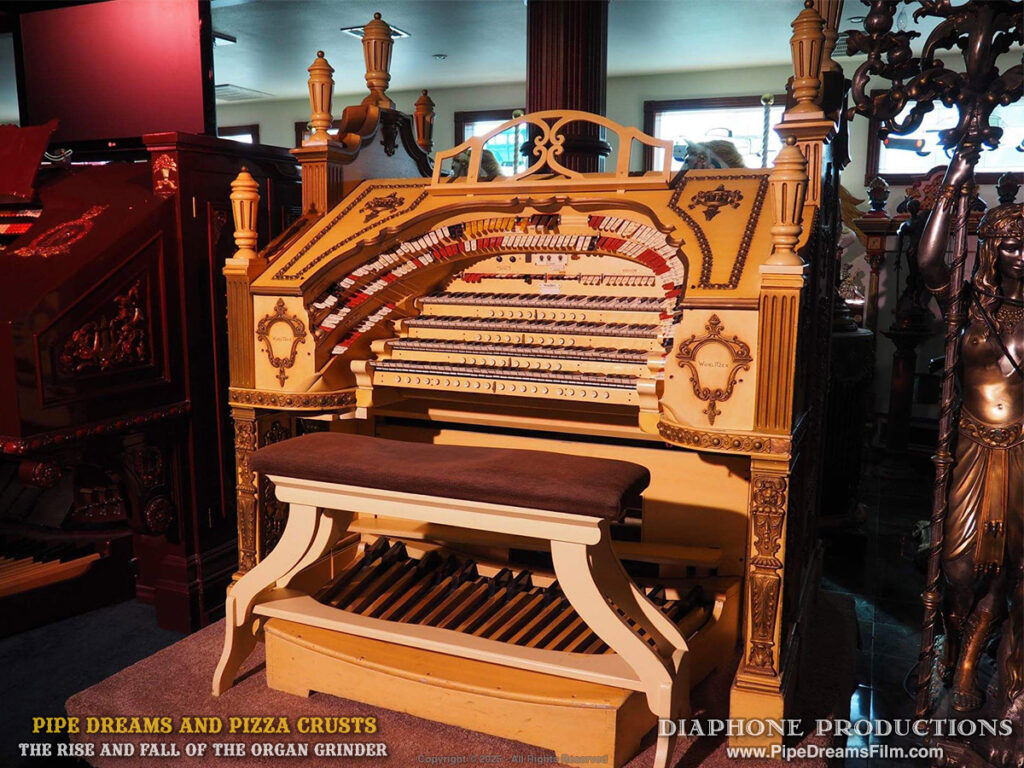
While the idea of having an instrument as large and as loud as Wurlitzer from Organ Grinder Denver in your living room may seem like extreme overkill, the Pikes Place Paradise main room was large enough to accommodate at least some of it, with very high ceilings and a spacious wall of mountain-view windows.
I had built intentionally a large living room with the idea of owning a theater pipe organ. But I knew also that I was going to have to add on to the structure for the chambers. But I was kind of waiting to see how all this was going to work out. So needless to say, we weren’t anticipating a 37 rank Wurlitzer. Suddenly the project became a lot more daunting and larger than we expected. That said, we, we did actually excavate for footings and start doing some work towards trying to create chambers for the Organ Grinder organ.
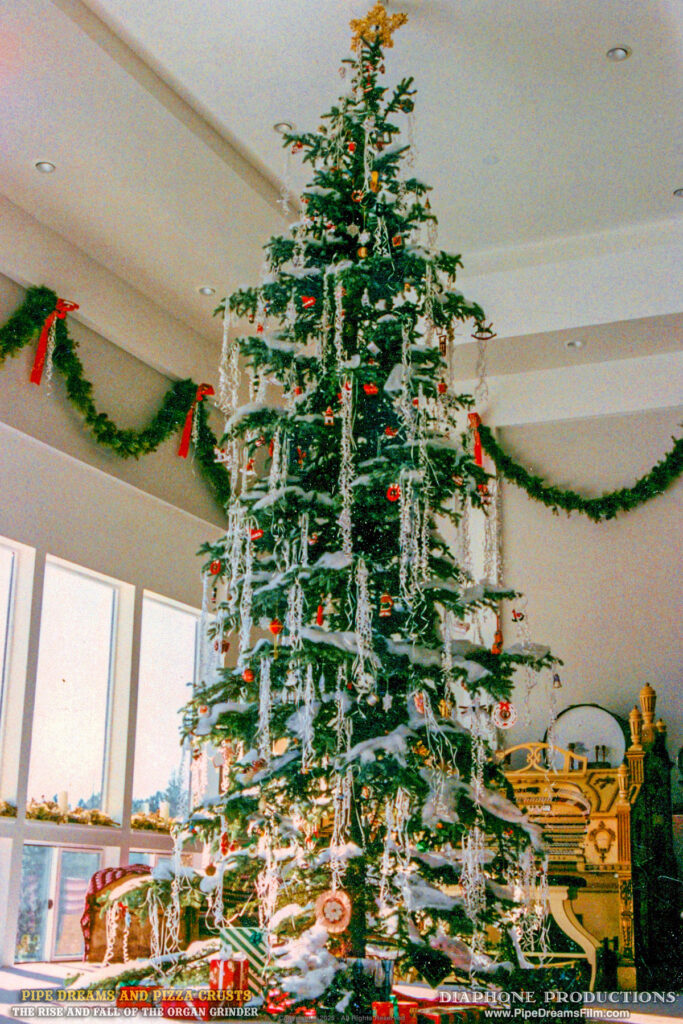
Martin and Tim continued operating the bed and breakfast with the intent of making the organ operational, hosting events with the organ as a backdrop.
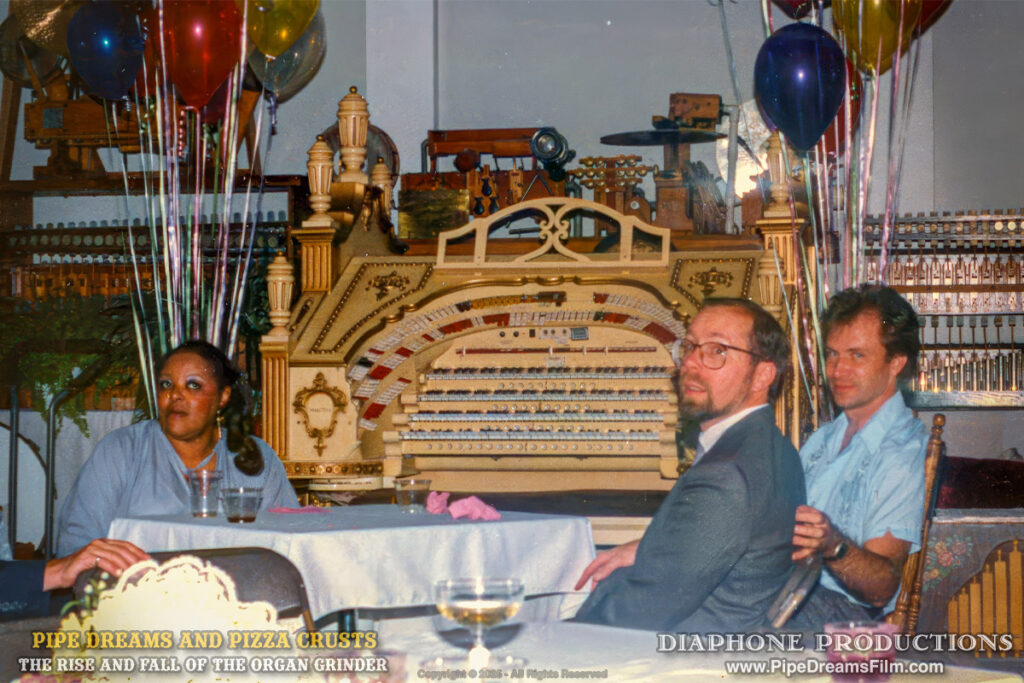
The two continued gradual work on the instrument, slowed by a struggling local economy, when tragedy befell them:
Tim had a serious accident – a pickup truck ran over his leg, and was not able to walk for seven years.
And so, we ended up with financial obligations with all of that. Things begin to fall apart – our dream began to fall apart. And finally, by about 1996 or 1997, we were starting to sell off the organ, because we realized that financially we just were not going to be able to set it up and make it play like we’d planned.
They first tried to keep the instrument together, and not part it out, as had happened to so many other instruments.
We did initially think we’d sell the organ as a whole to one entity. But nothing seemed to ever come together to keep the organ in one piece.
We realized that we would have to start selling it off. I held onto the dream as long as possible. The next level of what I did was to essentially sell off everything that was extra beyond the stock Publix model that was originally in the Portland Paramount theater. And that’s how it sat for a little while. But then things begin to erode financially even more, and then we were faced with having to liquidate it. And so the console went to the guys that owned the Castro theater in San Francisco [and later to the Maloof collection]. The chest work mostly went to a gentleman in Fort Worth, Texas.
We did have contact with the owner or one of the owners of the Oregon Stop Pizza in Mesa, Arizona. And originally they wanted to buy the diaphone [that went to Sanfilippo], and they were just too late with what their bid. But we were on friendly terms, and so there were other parts that headed towards Organ Stop. [Theatre organist] Lyn Larsen also ended up with a rank of bass pipes. It wasn’t one of the Wurlitzer pipes but it was one of the ones that was in the Organ.
(Organ Stop Pizza would later acquire the colorful 32ft diaphone pipes from Organ Grinder Portland after it closed in 1996.)
Martin and Tim did hang on to one bit of the Organ Grinder’s legacy until very recently, a small street organ that had once been at the Portland location, and then moved to Denver…
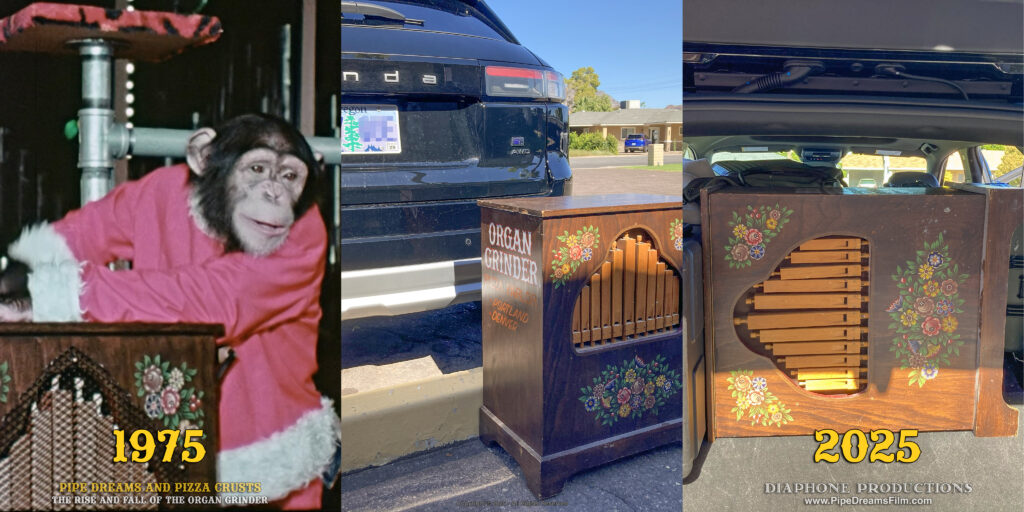
At the end of 2025, the couple moved out of the Phoenix area, and gave the street organ to a local organist, who in turn passed it along to the documentary project. The instrument made the drive (along with a car-load of camera gear) back to Portland, and is awaiting restoration.
Many thanks to Martin for participating in the interview (with Tim off-camera assisting with the recollections), and many thanks as well for sharing this little historic artifact from the restaurants with the project.
Will we ever solve the mystery of the Men in Black and the Six Month Deadline? Perhaps we can with your help!
You can help support the project by purchasing from the Crowdfunding Shop.