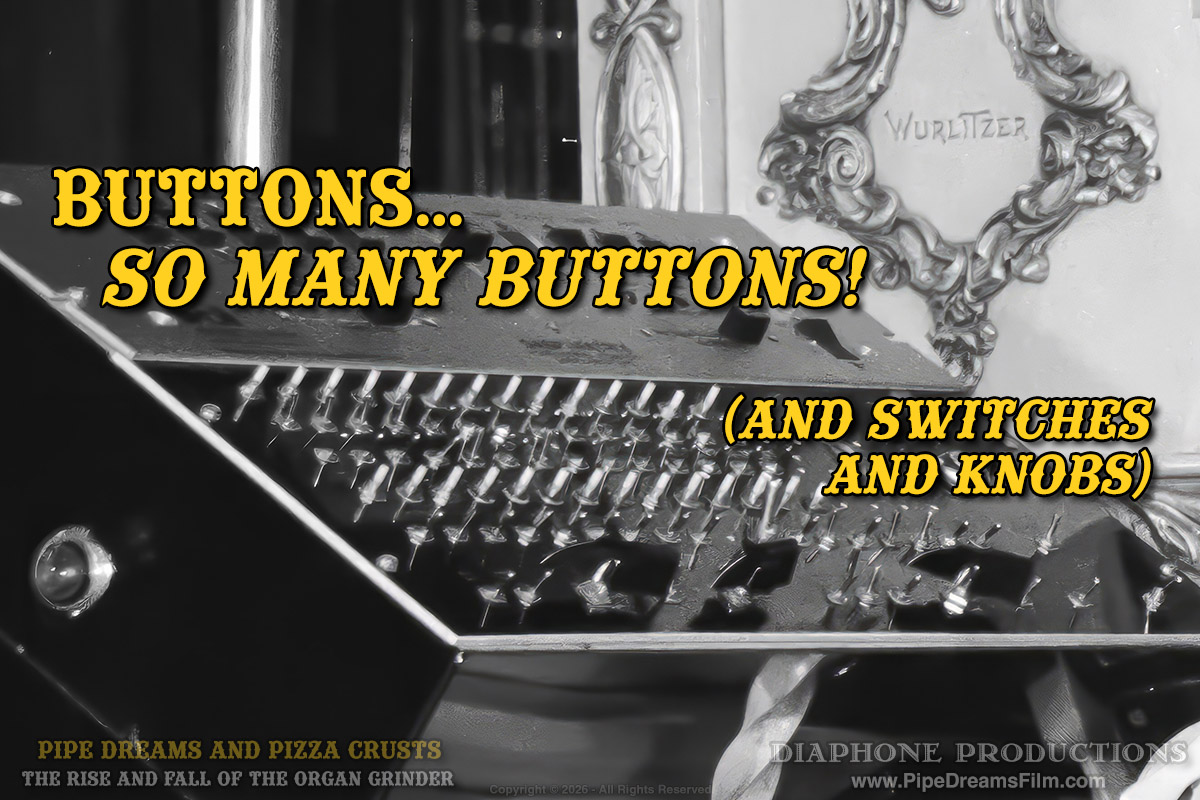
(And Switches and Knobs)
Playing a theatre pipe organ inherently requires keeping track of a lot of things simultaneously – with many controls such as:
- Stop tabs to select what sounds play
- Thumb pistons to recall preset combinations of settings
- Swell pedals to control the sound output of each enclosed chamber
- Couplers which can bring sounds from one manual to another or play them at different octaves
- “Second touch” which allows for different percussions and sounds to play selectively when you press a key deeper
- Various sound effects (“traps”) and percussions that can be engaged
And of course, powering up the blower and relay (the organ’s brain) that make everything possible.
But for the organists who performed regularly in pizza parlors, that was just the start! Depending on the restaurant, the organist could be responsible for:
- Lighting, including chasing/flashing effects
- Special Effects (bubbles, smoke, thunder/lightning)
- Animated contraptions – mechanical monkeys, singing ducks, dancing cats, acrobatic rag dolls, to name a few.
- A movie screen and projector or video player
- A sound system to address customers or play music during breaks
- Communicating with the staff & kitchen
- A rhythm unit playing real percussions, or a modern digital drum machine
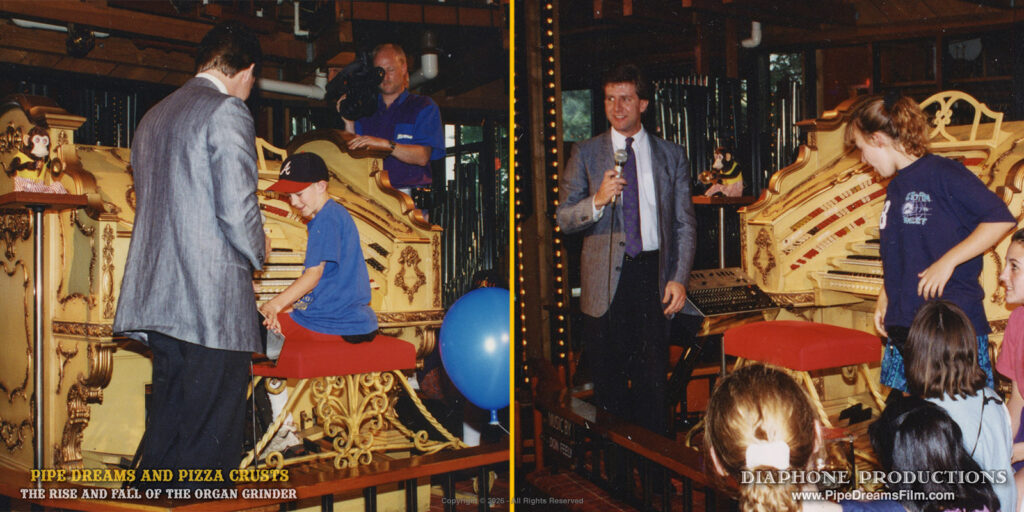
Recently, a commenter in our Facebook Group asked about the control panel which was placed at the left of the console at the Organ Grinder. Similar panels were installed at both the Portland and Denver locations, and their capabilities evolved over time.
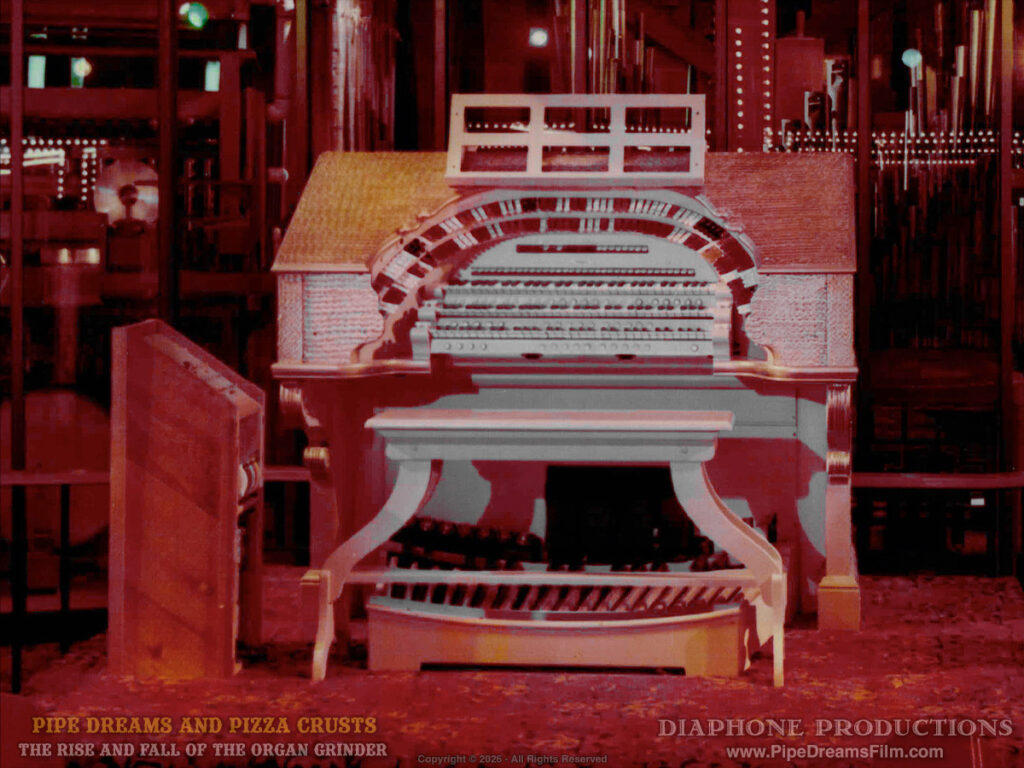
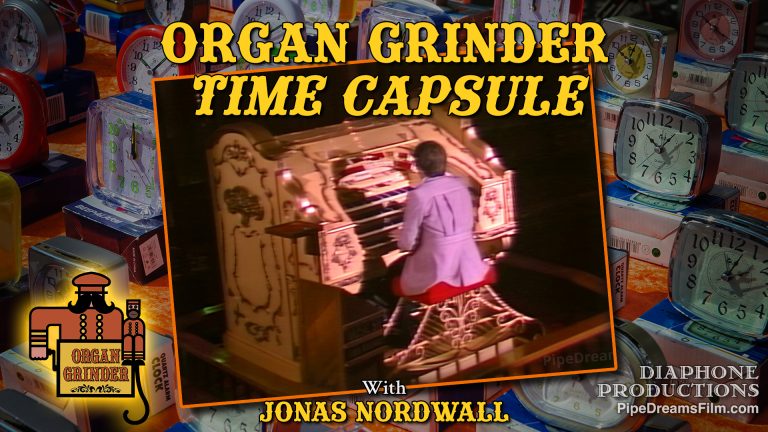
The original panel at Organ Grinder Portland was housed in a wooden cabinet, to the left of the 3-manual Wurlitzer console which came from the Oriental Theatre in Portland, Oregon.
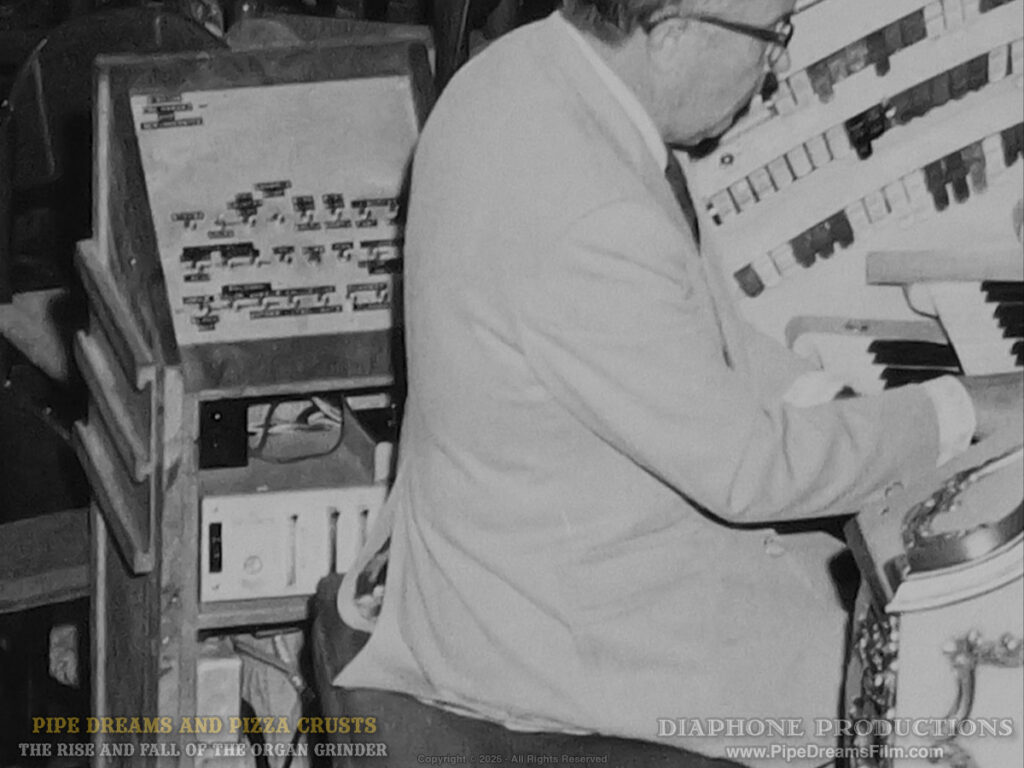
Later, Organ Grinder Portland’s console was upgraded to a 4-manual Wurlitzer console originally from the Metropolitan Theatre in Boston, Massachusetts.
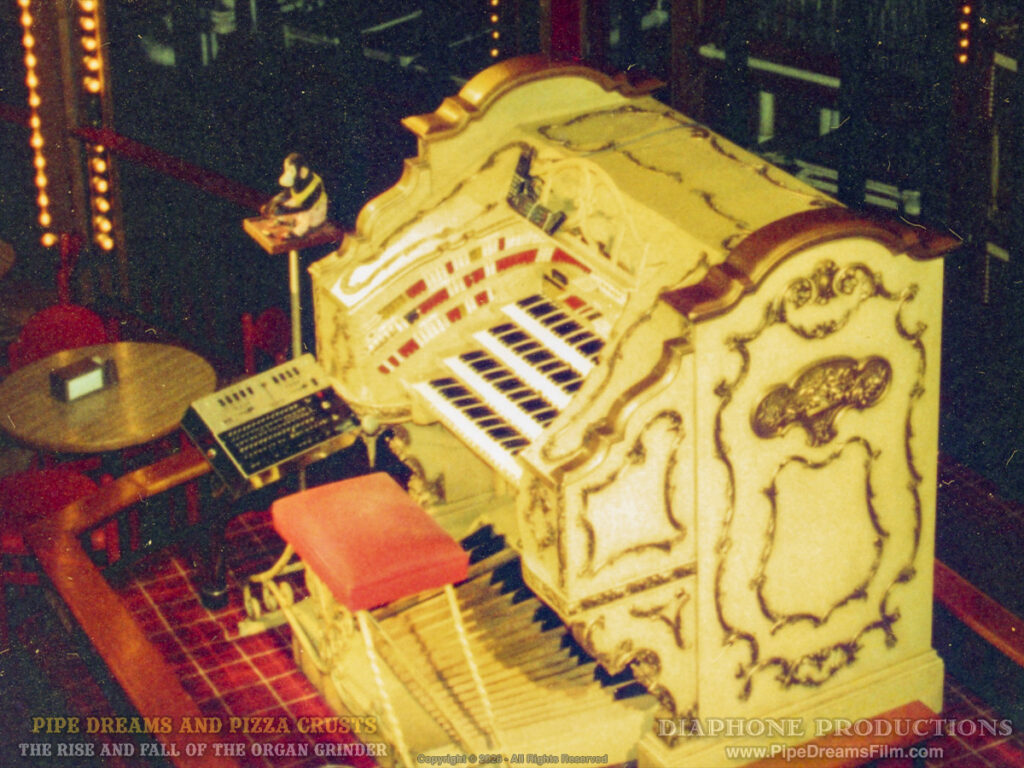
At around the same time, the panel was upgraded to a sleek chrome box atop an angled, cylindrical base.
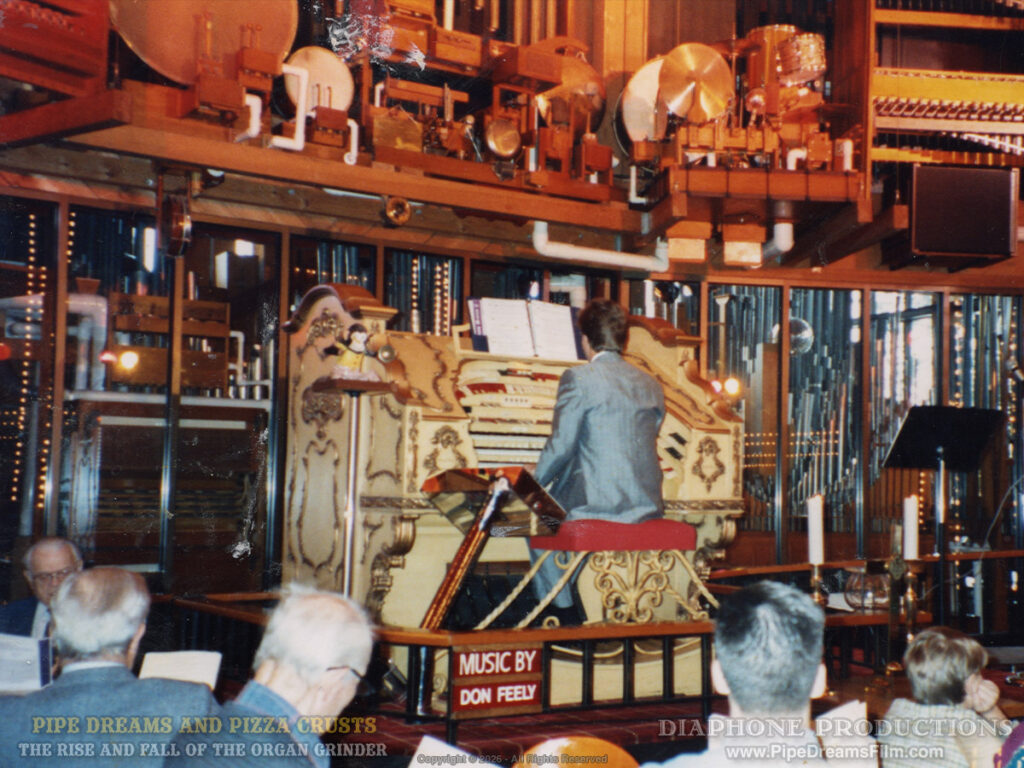
We asked Organ Grinder co-founder Dennis Hedberg, who installed and expanded the pipe organs at both locations, to describe them…
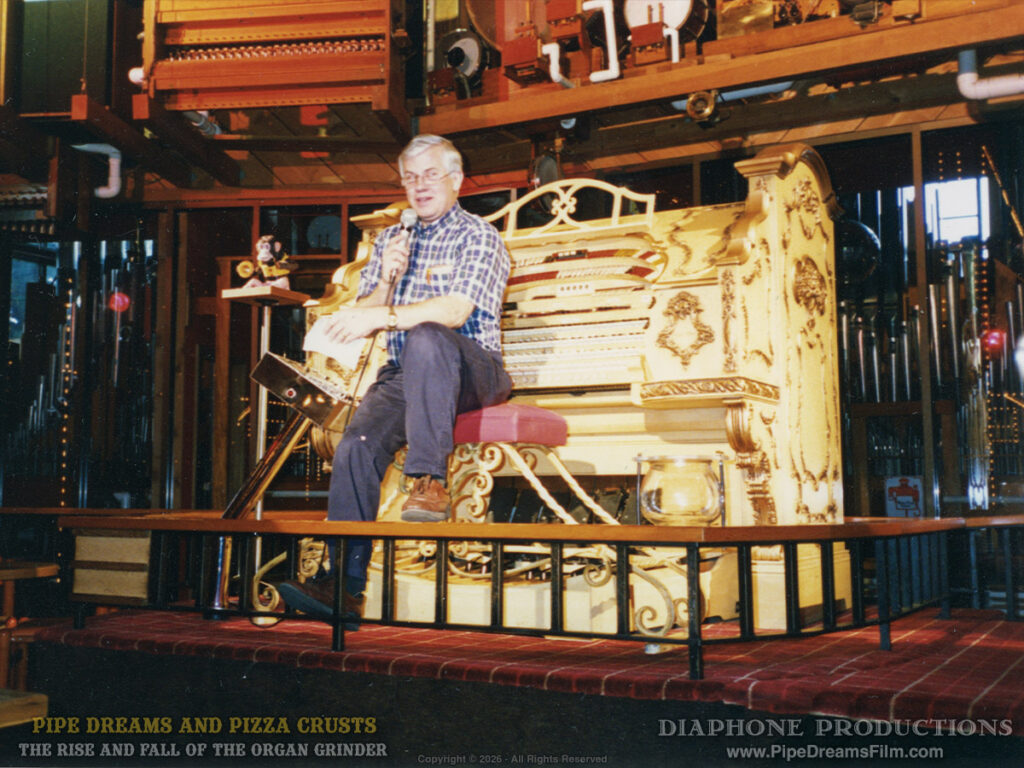
The Organ Grinder Lighting and Effects Panels
Dennis Hedberg – March, 2026
Although this writing describes Organ Grinder Portland, it is fundamentally the same for Organ Grinder Denver.
The panel close to the left side of the organ’s console had two main control functions… lighting and special effects, and organ special effects. Lighting was further separated into organ chamber lighting and house lighting.
Organ chambers had a mix of red-green-blue strip lights and a myriad 1000W Fresnel lens instruments fit with a variety of colored gels. They were dimmer controlled by a scanner programmed with multiple routines smoothly fading instruments from off to full brightness. But, in practice, organists pretty much left it alone doing its own thing.
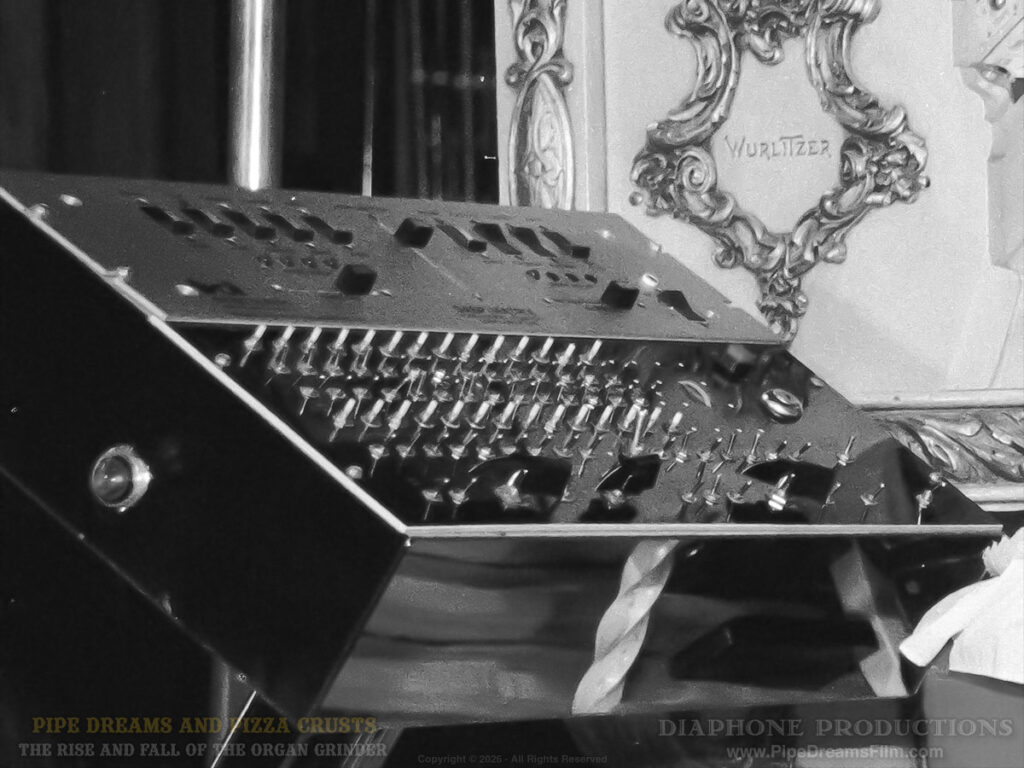
House lighting was divided into two categories. The first dealt with all those 6000+ 11W sign bulbs throughout the entire dining area. The bulbs were wired in strips each six feet long. Organists could choose to have the light strips remain static or have them flash sequentially, flash simultaneously or flash oscillatory.
There was one special switch that when on, caused the strip lights to advance one step sequentially, simultaneously or oscillating each time a pedal note was depressed.
The lower half of the control panel was populated with special effects switches including movie projector, screen up/down, kaleidoscopic projector, strobe light, Saturn ball, Saturn ball neon, bubble machines, red, green and blue Fresnel lens instruments, console spots and the not-to-forget clapping toy monkey.
The lower half also had two rows of toggle switches and/or momentary-contact button switches for controlling the organ’s wide assortment of non-pitch percussions and contraptions commonly called ‘traps’ or toys.
These included Bass Drum, Chinese Gong, Field Drum, Snare Drum, Tom Tom, Crash Cymbal, Tap Cymbal, Triangle, Shuffle, Chinese Block, Temple Blocks, Trotting Horse, Surf and Wind, Slap Tambourine, Shake Tambourine, Castanets, Police Whistle, Chirping Bird Whistle, Door Bell, Fire Gong, School Bell, Siren, Klaxon Horn, Dive Horn, Metal Roof Hail Shower, and probably a few more I can’t remember.
Two of the most important items on the Control Panel were the key-locked 60HP Blower start switch and Manager Call switch lighting a big red jewel on the panel’s left side.
Employees were trained to summon the manager immediately to address some issue the organist was having whenever that jewel was lit.
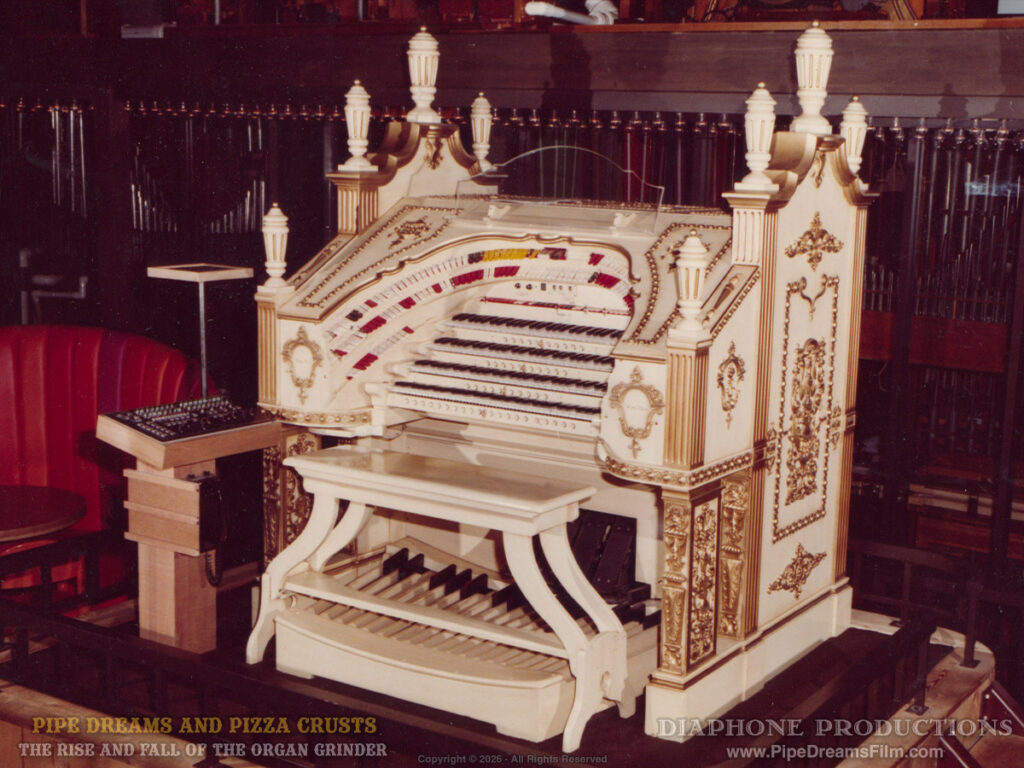
The Denver panel was the final one to be developed.
Theatre pipe organs were built to look and sound like they were larger than they really were. Wurlitzer consoles came in various standardized sizes. Usually, they could accommodate more stop tabs than needed for a given number of ranks so included stop tabs for any non-pitched orchestral percussions playable from the Pedal or Accompaniment manual. Non-orchestral noise makers were activated by buttons in key cheeks and swing-out panels under the key desk or by Pedal Toe Studs.
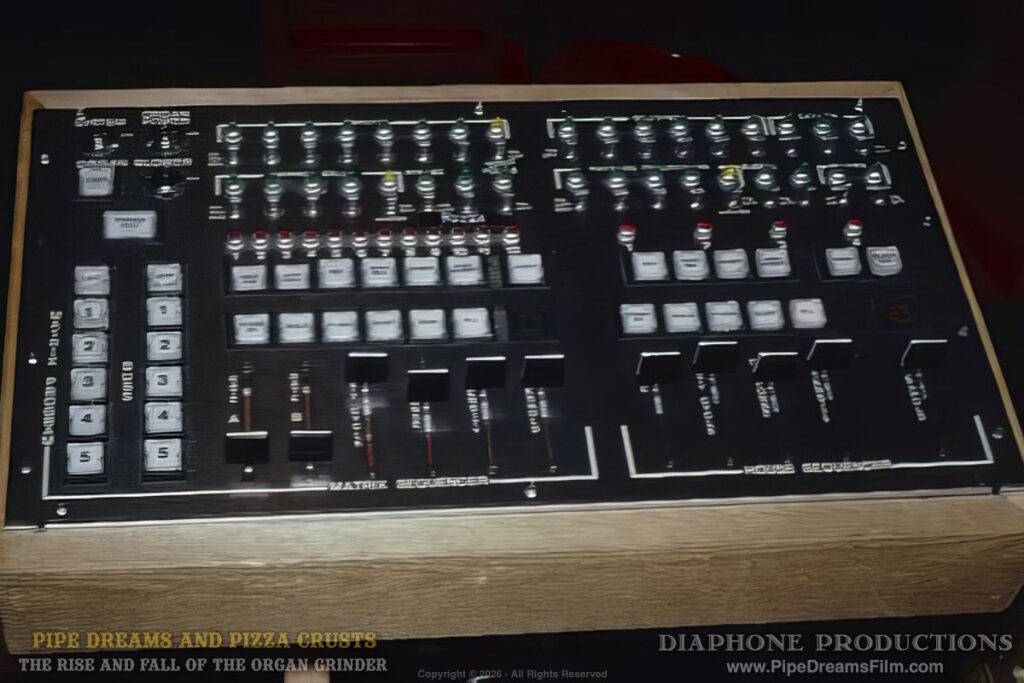
As many of you probably know, what became Organ Grinder Portland’s instrument began with 13 ranks, and a three manual console from the Oriental Theatre which rapidly grew to 34 ranks. It became necessary to offset or relocate anything to do with non-orchestral sound effects. This is what gave rise to the control panel the reader queried. In place of many stop tabs there are now just two named Selective Percussions—one each for Pedal and Accompaniment.
Returning to the Control Panel and its two rows of nearly identical switches and buttons: The upper row controlled ‘toys’ for the Accompaniment, the lower row for Pedal. Any switches in the up position will be activated no matter which key or keys will sound whenever the Selective Percussion tab for that manual is depressed. The lower row works the same only for the Pedal. Regardless of how many switches are on for either Accompaniment or Pedal, pressing its associated button will sound its noise maker.
Whenever Happy Birthday was played the organist wildly pressed nearly all of them resulting in a cacophonous sound.
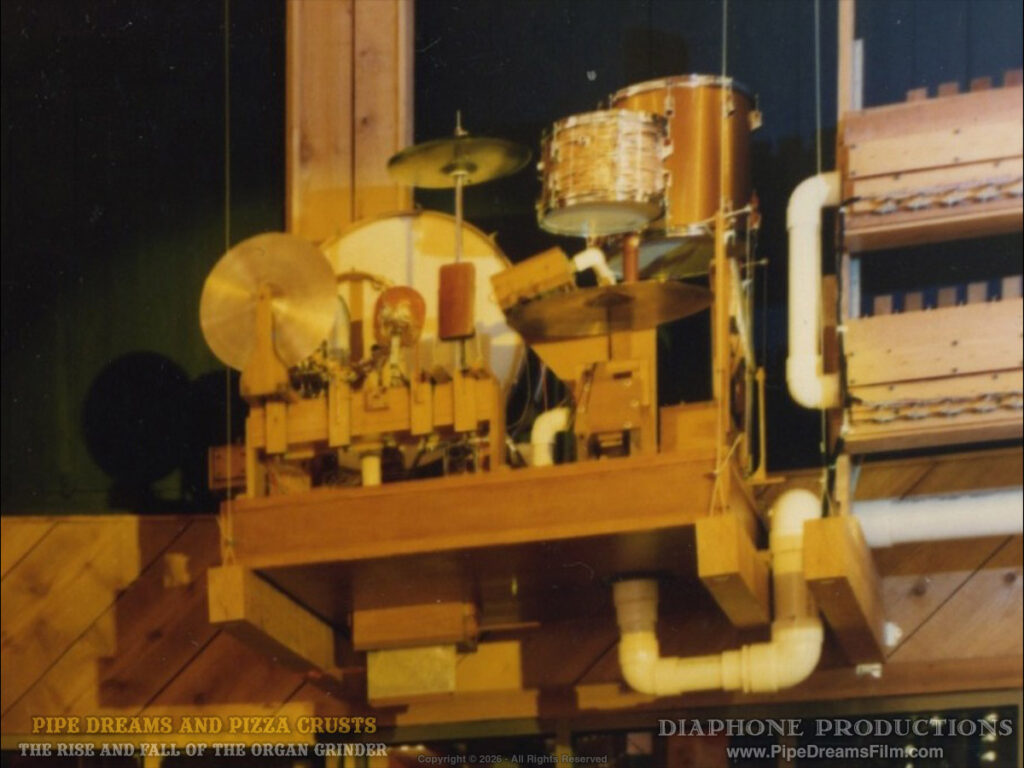
As long as we are talking about Organ Grinder’s non-pitched instruments and noise makers, there is a completely different arsenal controlled by a rhythm-pattern generator designed by Rodgers Organ Company and modified by them to drive electro-pneumatic non-pitched instruments.
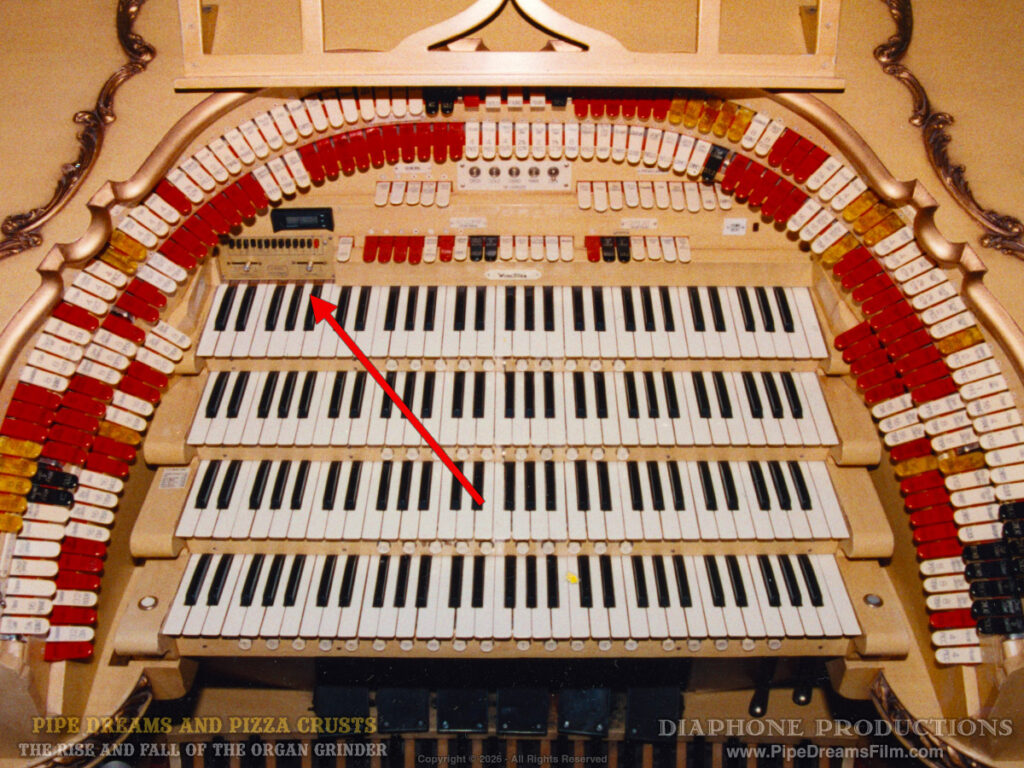
Its control panel was located just above the base end of the Solo manual. A black twelve-button switch selected twelve different rhythm patterns based on common meters – 2/4, 3/4, 4/4 and asymmetrical 5/4.
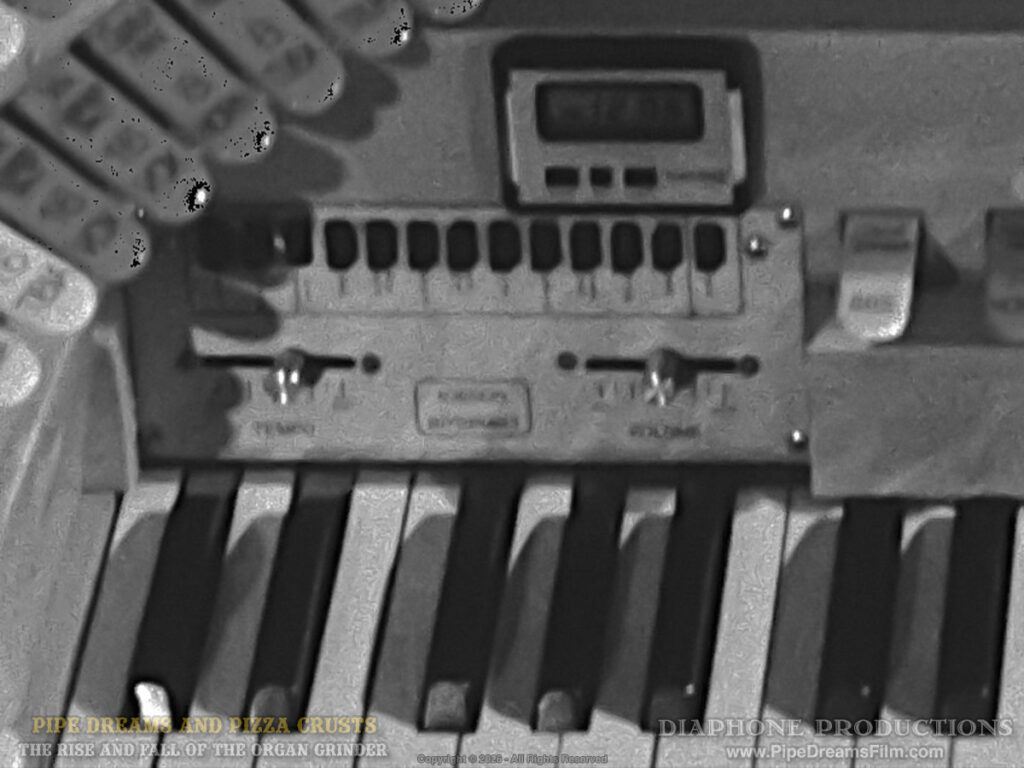
Below the buttons is a slider controlling tempo. A second slider, originally controlling volume, was repurposed to control reiteration frequency of the Solo to Great Pizzicato coupler.
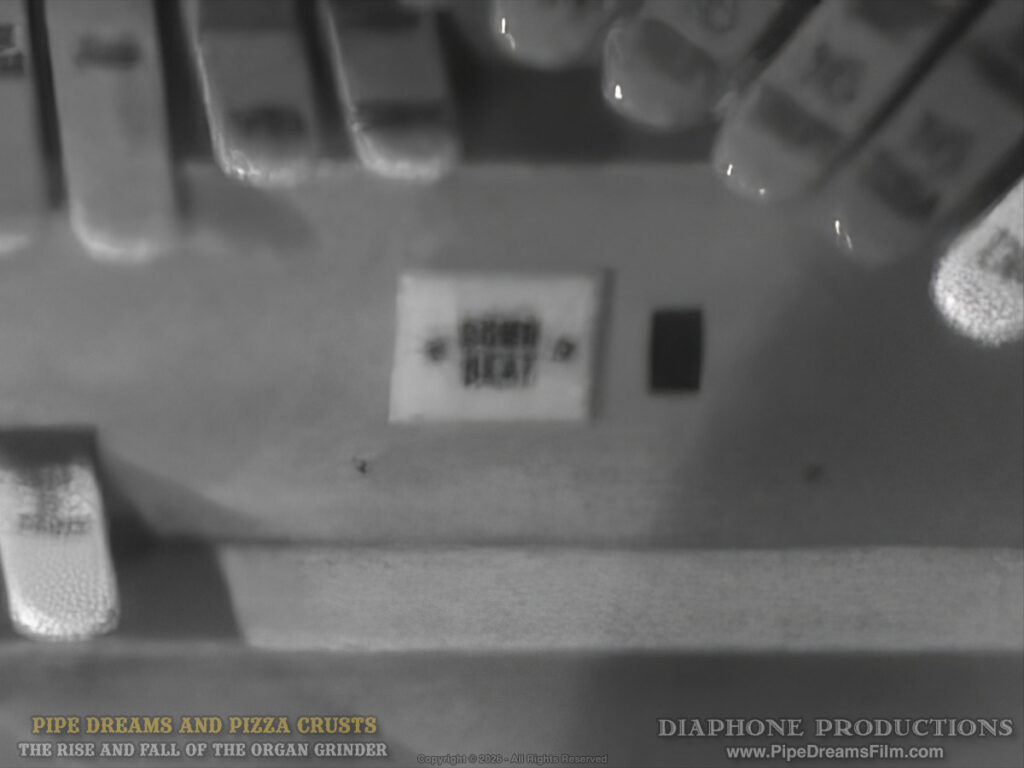
and red seven-segment LED to its right would display the current beat – 1, 2, 3, etc.
A single red button armed the rhythm generator starting it immediately when any note in the Pedal was depressed.
Special thanks to Dennis Hedberg for writing this up for us!
You can help support the project by purchasing from the Crowdfunding Shop.
Sign up for our email newsletter and receive updates about the project.